Language

Monday, August 28, 2023

The science of tricks


The science of tricks is the Arabic name for what is called the science of mechanics, and its aim is to know how to obtain a great action with little effort, and that is why the Arabs called it tricks, the use of tricks in place of strength, the mind in place of muscles, and the machine instead of the body.

The values and morals of the message of Islam had a great role in prompting Muslims to pay attention to this science and to develop machines to provide more capabilities and energies. If other civilization relied on forced labor in obtaining benefits for the elites and upper classes of rulers, princes and people of prestige, then Islam forbade entrusting what is not required. Unbearable, and the exhaustion of servants and slaves, and even animals as well, so there was an urgent need to use machines that save effort and energy and achieve large production with minimal effort.

Al-Khwarizmi considered the science of tricks as one of the eight main sciences, and divided it into two branches: dragging weights with easy force, tricks of water movements, and the manufacture of wondrous utensils and the related craftsmanship of moving machines themselves.

 Among the most important books written in the science of tricks is the book “Al-Hil” by the sons of Musa bin Shaker, in the third century AH, and they formed a scientific team among themselves, and they wrote this book that contains a hundred mechanical structures with explanations and illustrations of operating and installation methods, eighty of which are of type Which the Arabs called "wonderful pots", which are devices that work automatically, and the rest are from the fountains that change their shapes automatically at certain periods of time, and from the lamps that feed themselves automatically and from other devices, including a mechanical bulldozer to pick things up from the bottom of the seas or rivers, and these devices were the nucleus that The science of cybernetics developed from it.

 And the book “The Combiner between Knowledge and Useful Action in the Industry of Tricks” by Badi’ Al-Zaman Abi Al-Ezz bin Ismail Al-Razzaz Al-Jazari, who lived in the sixth and seventh centuries AH, is also one of the important books in this field, and this book is considered the greatest book of its kind in mechanical engineering until modern times, This book included various designs for automatic clocks and levers; In which linear motion is transferred to circular motion by means of toothed gears, which is the basis on which modern motors are built.

 There is the book “Asrar fi Nahat al-Afkar” by Ahmed bin Khalaf al-Muradi, who lived in the fifth century AH. It includes an explanation of more than thirty types of mechanical machines, a highly developed sundial, and important parts about mills and water presses.

And the book “Sunni Methods of Spiritual Instruments” by Taqi al-Din ibn Ma’ruf al-Dimashqi, who lived in the tenth century AH. In this book, many mechanical devices are described; such as hourglasses, water and automatic machines, levers with pulleys, gears, water fountains, and spinning machines. This book is of special importance. As it was written in the era of the European renaissance, but the history of the book precedes the dates of books written in Europe on the same subject. The author of the book finished it in the year 1552 AD, i.e. before the book “Agricola” appeared in the year 1556 AD, and the book “Ramelli” in the year 1588 AD, and in the book “The Sunni Paths” he described mechanical machines before a similar description was given in Western references, and technology historians thought that the first description For these machines was in the books of Agricola and Ramelli.

It was confirmed that Muslim scholars preceded the laying down of sound scientific foundations for the three laws of motion formulated by Newton, and Muslims dealt with the laws of science of tricks or mechanics in a scientific way, not out of superstition, fortune-telling, and contact with the world of jinns and demons, or the supernatural powers of gods, as was happening in other nations in order to Controlling peoples and ensuring their service to a small class of rulers and soothsayers.

The exploits of Muslim scholars in the field of the science of tricks are one of the pages of the bright history of Muslims, which needs a new resurrection in which Muslims are interested in the various sciences of the universe in order to achieve civilizational progress that helps achieve the goodness of this nation, and qualifies for its survival in competition with the development of humanity.

Sunday, August 27, 2023

Mathematics for Muslims

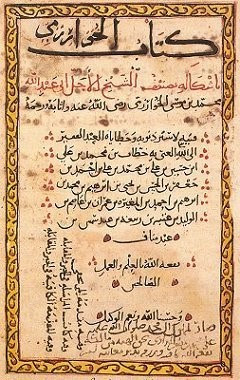
Al-Khwarizmi's Concise Book on Calculating Algebra and Contrast, one of the pages of the book
.

In Baghdad, al-Khwarizmi established the science of algebra and counterpoint in the early ninth century. During the succession of Abu Jaafar al-Mansur, some of the works of the ancient Alexandrian scholar Ptolemy T. were translated. 17 AD)، the most important of which is his book known as “Almagest”. And the name of this book in Greek is “EMEGAL MATHEMATIKE,” meaning the greatest book in arithmetic. The book is an encyclopedia of knowledge in astronomy and mathematics. Muslim scholars benefited from it and corrected some of its information and added to it. On the Indian language, many works were translated, such as the famous Indian book on astronomy and mathematics, Siddhanta, meaning “knowledge, science, and doctrine.” The Arabic translation appeared during the reign of Abu Jaafar al-Mansur under the title Al-Sind Hind. Muslims have the zero system, which made Arab mathematicians solve many mathematical equations of various degrees. It facilitated its use for all arithmetic work, and the numbering system rid itself of complexity. The use of zero in arithmetic operations led to the discovery of the decimal fraction, which was mentioned in the book Key to Arithmetic by the mathematician Jamshid bin Mahmoud Ghiyath al-Din al-Kashi (d. 840 AH, 1436 CE), and this discovery was the real introduction to infinitely small arithmetic studies and operations. Ibrahim al-Fazari extracted an astronomical arithmetic table showing the positions of the stars and calculating their movements, which is known as zigzag


Among the scholars of the House of Wisdom in Baghdad was Muhammad ibn Musa al-Khwarizmi (d. 232 AH 846 CE), whom al-Ma’mun entrusted with writing a book on the science of algebra. Ibn Khaldun said: Algebra and contrast (i.e. equation) are branches of the number sciences, and it is an industry by which the unknown number is extracted from the known number if there is a connection between them that requires that, then it is opposite each other, and the fraction in it is forced until it becomes correct. Algebra is an Arab science that the Arabs called it with a word from their language, and it was Al-Khwarizmi who gave it this name that moved to European languages with its Arabic word ALGEBRA. This book was translated into Latin in the year 1135 AD. He continued studying at universities in Europe until the 16th century. Arabic numerals also moved to Europe through translations of Al-Khwarizmi’s books, which he called ALGORISMO in Latin, then ALGORISMO was modified to denote the system of numbers, arithmetic and algebra, and the method of solving mathematical problems. It has the name “Al-Sind Hind Al-Saghir”, and it combined the doctrine of India, the doctrine of the Persians, and the doctrine of Ptolemy (Egypt). West Mathematical Sciences was quoted as Arabs and developed. And define the Abacus account: Abacus. Or Abacus. (Counting plate). It is a frame with balls for manual counting. This painting was used by the Greeks, Egyptians, Romans and some European countries before the arrival of the Arab account in Europe in the thirteenth century. Addition, subtraction, multiplication and division were carried out through the counting board. Ibn Al-Haytham was also the first to extract the general formula for the sum of the arithmetic sequences of the fourth degree (mathematics) in mathematics.


An old Arabic manuscript dating back to the seventeenth century on geometry and astronomy

The Arabs worked with algebra and were familiar with it in a scientific and organized manner, so that Kajuri said: “The mind is amazed when it sees what the Arabs did in algebra…” Among the most famous books that the Arabs wrote are: “Algebra and the Matching” by Al-Khwarizmi, as well as the book of Khayyam, which he published (Wobek in the year 1851 AD); The Arabs divided the equations into six sections and developed solutions for each of them, and used symbols in mathematical works and researched the binomial theory, and created a law to find the sum of natural numbers, and dealt with deaf roots and paved the way for the discovery of logarithms. In the thirteenth century A.D., the mathematical sciences of the Arabs and others began to spread to Europe through Andalusia, so they translated the writings of the Arabs in various sciences, including algebra, so the monk Jordanes (about 1220 AD) replaced words in algebraic expressions with symbols, and his contemporary Fibonaki did the same and wrote a book on arithmetic And Principles of Algebra, he explained his influence on the writings of Al-Khwarizmi and Abu Kamel, the two Arab worlds. In the sixteenth century, scientists reached the solution of equations of the third and fourth degrees, and in the seventeenth and eighteenth centuries, they reached impressive results in their research on power series and their properties.

Among the most prominent achievements of Arab Muslims in mathematics:

787 A.D. The numbers and the zero drawn in the form of a dot appeared in Arabic literature before they appeared in Indian books.

830 AD, the Arabs gave this name to the science of algebra for the first time.

835 A.D. Al-Khwarizmi used the term as-saam for the first time to refer to a number that has no root.

888 A.D. Arab mathematicians laid the first building blocks of analytical geometry, using geometry to solve algebraic equations.

912 AD Al-Battani used the sine instead of the double bowstring in measuring angles for the first time.

1029 A.D. Arab mathematicians took advantage of plane and stereoscopic geometry in light research for the first time in history.

1252 A.D. Nasir al-Din al-Tusi drew attention - for the first time - to Euclid's mistakes in parallels.

1397 AD Ghiyath al-Din al-Kashi invented decimal fractions.

1465 A.D. Abu al-Hasan al-Qurashi put for the first time symbols for the science of algebra instead of words.

Saturday, August 26, 2023

صناعة الزجاج

صناعة الزجاج

مصانع الزجاج

في القرن الثامن الميلادي؛ تأسس أول مجمع صناعي لإنتاج الزجاج والخزف في مدينة الرقة السورية. جرت العديد من التجارب في ذاك المجمع البالغ طوله نحو 2 كم لتطوير زجاج عالي النقاوة، كما اكتشف موقعين مماثلين لهذا المجمع، فأصبح الزجاج في تلك المواقع الثلاث ينتج بطرق كيميائية مختلفة تصل إلى ثلاثمائة طريقة.

تأسست أول مصانع الزجاج في العالم الإسلامي بأيدي عمال مسلمين في القرن الثامن، في حين أن مصانع الزجاج في أوروبا بُنيت لاحقاً في القرن الحادي عشر على أيدي حرفيين مصريين من مدينة كورنث اليونانية

الزجاج الصافي الشفاف عالي النقاوة

أُنتجت أقدم نماذج الزجاج الصافي الشفاف عالي النقاوة من قبل المسلمين في القرن التاسع الميلادي، ومثال ذلك زجاج الكوارتز المنصهر الذي اخترعه عباس بن فرناس.


نوافذ بزجاج معشق ملون في مسجد ناصر الملا في مدينة شيراز في إيران.

الزجاج الملون والمعشق

أُنتج الزجاج المعشق لأول مرة من قبل المعماريين المسلمين في جنوب غرب آسيا باستعمال الزجاج الملون بدل الحجارة (التحجير). في القرن الثامن وصف العالم الكيميائي جابر بن حيان في كتابه «الدرة المكنونة» ستًا وأربعين طريقة لإنتاج الزجاج الملون، بالإضافة إلى اثني عشرة وصفة أخرى كتبها المراكشي في نسخ لاحقة من الكتاب

اللآلئ والأحجار الكريمة

وصف جابر بن حيان في كتاب «الدرة المكنونة» أول طريقة أو وصفة لإنتاج اللؤلؤ الصناعي، كما وصف طرق تنقية اللآلئ من الشوائب عند تغير لونها من البحر أو من الشحوم المختلفة

أما بالنسبة للأحجار الكريمة فقد وصف جابر أول طريقة لصباغة الأحجار الكريمة واللآلئ وتلوينها بلون اصطناعي كما وصف طريقة إنتاج الزجاج الملون عالي الجودة الذي كان يشذب إلى أحجار كريمة اصطناعية.[

المرايا

وصفت مرايا القطع المكافئ (مرايا على شكل قطع مكافئ) لأول مرة من قبل ابن سهل في كتابه «عن الأدوات الحارقة» في القرن العاشر الميلادي، كما وصفت لاحقاً من قبل ابن الهيثم في كتابه عن المرايا الحارقة وكتاب المناظر عام 1021.

كما ناقش ابن الهيثم خواص المرايا المقعرة والمحدبة في الشكلين الأسطواني والكروي، ووصف المرايا الكروية ومرايا القطع المكافئ وأجرى عدداً من التجارب على المرايا، وأوجد حلاً لمشكلة تحديد نقطة على مرآة محدبة، والتي ينعكس عليها الشعاع الوارد من نقطة إلى نقطة أخرى. وبحلول القرن الحادي عشر بدأت صناعة المرايا من الزجاج النقي في الأندلس

زجاج الكوارتز والسيليكا

اخترع عباس بن فرناس (810-887) زجاج الكوارتز والسيليكا الشفاف عالي النقاوة، وكان أول من أنتج الزجاج من الرمل والصخور مثل الكوارتز المنصهر.


Thursday, December 12, 2013

Golden Ages -The first mobile robot for service in homes

The golden Ages


I did not imagine the day that I find this sea of knowledge always they tell us in the shares of contemporary history from that era of Time - Middle Ages - it ages dark spread its evil, ignorance and disease, but today I realized that those times of evil and ignorance and disease were not but in a small spot of land there is always a glimmer of light appear in another place is the east
When Europe was drowning in ignorance and disease was blessed with good Middle and prosperity and modern science that preceded its age. It's really the golden ages


The first mobile robot for service in homes
Lots and lots of discoveries and inventions of high-tech, guiding the lost time and laid the foundation for all contemporary inventions have had one goal is to serve humanity and the challenge of evil, 
ignorance and disease.

Did you know he was the invention of the first robot in the 12th 
century AD?


Yes, this happened at the hands of the inventor Badi'ozaman bin Razi Jazari he invented the first mobile robot for service in homes
Did so when asked the Prince of Diyarbakir making machine is spared for a butler whenever he wishes to ablution
And he made his machine as a boy standing upright in one hand water jug ​​in the other towel and turban bird If it's prayer time warbling bird then advanced server about Prince and hurt him water from a jug by a certain amount If finished ablution give him the towel and then goes back to his place and the bird sings.

Jazari's book named for science and the useful work contained tens of fees for the machines operate mechanical engineering and water resources, including time, including the robot, including the machine, including the safe ablution with figures

Sunday, July 21, 2013

Tuesday, May 7, 2013

"Einstein the Arabs" died poisoned

Professor Ali Mustafa Mosharafa


Professor Ali Mustafa Mosharafa
One of the scientists who found their bodies covered with question marks. He died on January 16, 1950 in a very primitive way .. Poison.

May be the Egyptian monarchy at that time role in the killing, especially if we know that the professor. Senior he formed the group under the name "Egypt's youth," it includes a large number of intellectuals, scientists and students, and was designed to exclude system Farouk monarchy and declare an independent Arab Republic of Egypt. And shot to is this secret group The news reached the royal palace, which gives the palace excuse to get rid of a professor. Mustafa. The World Zionist it is sufficient to say that the outlook for the student genius professor. Samira Moussa will not differ from their approach to mentor the most genius Mustafa superintendent, and played dirty Zionism played a physical liquidation, and one look was meant to get rid of them and like them.
And Mostafa Mosharafa is the world of mathematics and physics Egyptian born in 1898. In 1917 was chosen for a scientific expedition for the first time to England. He joined "Ali" Faculty Nottingham Nottingham then Faculty of the "King" in London, where he received a Bachelor of Science with honors in 1923. Then earned a Ph.D (Doctor of Philosophy) from the University of London in the shortest period allowed by the laws of the university. Egypt has returned to the order of the ministry, and was appointed as a teacher at the Supreme teachers, then traveled back to England and received a Doctor of Science degree D.Sc was the first Egyptian to get it. In 1925 he returned to Egypt, and was appointed professor of Applied Mathematics at the Faculty of Science at the University of Cairo, and then grant the degree of "Professor" in 1926 despite the objections of the university law to grant title to anyone who is less than thirty. Appointed professor "Ali honorable" Dean of the Faculty in 1936 and was elected to the deanship four times sequences, also elected in December 1945 as an agent of the university. Research began Dr. "Ali honorable" take their place in scientific journals and old did not exceed fifteen years. In London's Royal University of King's College has published the first five research on quantum theory for which they received my degree Ph.D (PhD) and Dsc. (The Doctor of Science). Kanalastaz honorable made the first scientific research on finding a vacuum gauge, where it was based on vacuum engineering theory of "Oenchen" subject only to the movement of a particle moving in the gravitational field. We have added new theories to explain radiation from the sun, but the theory of Dr. supervisor at radiation and the speed of the principal theories and the cause of his fame and universality, as demonstrated by Dr. honorable that Article radiation in origin, and can be considered as two for one thing becomes one of the other .. I have this theory paved the material world to turn to atomic radiation.
Dr. "Ali" one of the few who knew the secret of the fragmentation of corn and one of the scientists who fought used in the war .. It was first added a new idea is that hydrogen can be made from such a bomb .. However, he did not wish to make bomb Aloedrugenih, which is what happened years after his death in the United States and Russia .. Research estimates, "Ali honorable" excellence in quantum theories, corn and radiation, mechanics and thermodynamics about fifteen search .. The total drafts of scientific research before his death to about two hundred .. Perhaps Dr. was collected intends to get out on the Nobel Prize in mathematics. Was invited by the German scientist Albert Einstein originally to participate in the dumping of research related to maize in 1945 as a visiting professor for a year, but he apologized, saying: "In the national needs to generation"


Professor Ali Mustafa Mosharafa
One of the scientists who found their bodies covered with question marks. He died on January 16, 1950 in a very primitive way .. Poison.
 Prof. Ali Mostafa Mosharafa - the first Egyptian to participate in space research, and even more importantly, it was one of the disciples of the world Albert Einstein, and it was one of his most important aides in access to the theory of relativity, and was a professor. Honorable title of "Einstein the Arabs", and now the circumstances of his untimely death too vague, and all the surrounding circumstances indicate that he was murdered either by a representative of King Farouk, or at the hands of international Zionism, and each cause.
May be the Egyptian monarchy at that time role in the killing, especially if we know that the professor. Senior he formed the group under the name "Egypt's youth," it includes a large number of intellectuals, scientists and students, and was designed to exclude system Farouk monarchy and declare an independent Arab Republic of Egypt. And shot to is this secret group The news reached the royal palace, which gives the palace excuse to get rid of a professor. Mustafa. The World Zionist it is sufficient to say that the outlook for the student genius professor. Samira Moussa will not differ from their approach to mentor the most genius Mustafa superintendent, and played dirty Zionism played a physical liquidation, and one look was meant to get rid of them and like them.
And Mostafa Mosharafa is the world of mathematics and physics Egyptian born in 1898. In 1917 was chosen for a scientific expedition for the first time to England. He joined "Ali" Faculty Nottingham Nottingham then Faculty of the "King" in London, where he received a Bachelor of Science with honors in 1923. Then earned a Ph.D (Doctor of Philosophy) from the University of London in the shortest period allowed by the laws of the university.
Egypt has returned to the order of the ministry, and was appointed as a teacher at the Supreme teachers, then traveled back to England and received a Doctor of Science degree D.Sc was the first Egyptian to get it.
In 1925 he returned to Egypt, and was appointed professor of Applied Mathematics at the Faculty of Science at the University of Cairo, and then grant the degree of "Professor" in 1926 despite the objections of the university law to grant title to anyone who is less than thirty.
Appointed professor "Ali honorable" Dean of the Faculty in 1936 and was elected to the deanship four times sequences, also elected in December 1945 as an agent of the university.
Research began Dr. "Ali honorable" take their place in scientific journals and old did not exceed fifteen years. In London's Royal University of King's College has published the first five research on quantum theory for which they received my degree Ph.D (PhD) and Dsc. (The Doctor of Science).
Kanalastaz honorable made the first scientific research on finding a vacuum gauge, where it was based on vacuum engineering theory of "Oenchen" subject only to the movement of a particle moving in the gravitational field.
We have added new theories to explain radiation from the sun, but the theory of Dr. supervisor at radiation and the speed of the principal theories and the cause of his fame and universality, as demonstrated by Dr. honorable that Article radiation in origin, and can be considered as two for one thing becomes one of the other .. I have this theory paved the material world to turn to atomic radiation.
Dr. "Ali" one of the few who knew the secret of the fragmentation of corn and one of the scientists who fought used in the war .. It was first added a new idea is that hydrogen can be made from such a bomb .. However, he did not wish to make bomb Aloedrugenih, which is what happened years after his death in the United States and Russia ..
Research estimates, "Ali honorable" excellence in quantum theories, corn and radiation, mechanics and thermodynamics about fifteen search .. The total drafts of scientific research before his death to about two hundred .. Perhaps Dr. was collected intends to get out on the Nobel Prize in mathematics.
Was invited by the German scientist Albert Einstein originally to participate in the dumping of research related to maize in 1945 as a visiting professor for a year, but he apologized, saying: "In the national needs to generation"

Wednesday, October 31, 2012

History of Islam Sciences


History of science is a actual conduct as its name signifies, and as such it is sometimes black by historians’ biases. There are analytical issues that defied attempts to ability the accuracy about them such as the aboriginal analysis of nitric acid, the analysis of alcohol, the aboriginal conception of atomic gunpowder, the aboriginal cannon, how the ambit accomplished Europe, and the catechism of whether the columnist of the Latin works of Giber was Giber Ban Hayyan or a Latin author.

Even a specific Latin columnist is afresh appropriate to alter the pseudo-Giber.
History of science cannot be accounting on the base of assumptions and conjectures. This cardboard will abridge the after-effects of a contempo analysis into this problem. It is hoped that it will active historians of science into alarmingly re-examining this accomplished catechism again.
Transmission of Arabic abracadabra into the Latin West – a abrupt review
The works attributed to Jabir bin Hayyan are actual ample in number. Giber’s works awning about every acreage of acquirements abnormally alchemy. There are about several treatises on applied abracadabra attributed to Giber that became accepted alone in the accomplished few decades.

Some of Giber’s works abide alone in Latin and their Arabic originals in the libraries of the West were absent and cannot be located. This is what had happened to the majority of added aboriginal Arabic works that were translated into Latin.

The doubts aloft by Paul Kraus on the antecedent of the Giberian bulk and the agitation that ensued accept no address on our analysis into the agent of Geber’s Latin works. It does not bulk whether Giber himself was the columnist or a after pseudo-Giber. Similarly the religious behavior of Geber do not affect his scholarship and has no appulse on our investigation.

Before the adaptation of the Arabic works into Latin, abracadabra was alien in the Latin West. Robert of Chester accomplished in the year 1144 the aboriginal adaptation from Arabic of a book on alchemy, Libber de blended one abracadabra “The Book of the Composition of Abracadabra ”, which is the argument of a chat amid the abbot Maryanus (Morienus) and Prince Khalid bin Yazid (d. 704 AD). Until recently, doubts were casting on the captivation of Khalid ibn Yazid in abracadabra and on his appointment with Maryanus. Even the adaptation by Robert of Chester was questioned, and a historian of science like Julius Ruska attributed the Libber de blended one alchemies to an Italian of abundant after date. But these doubts were expelled afresh with the analysis of the Arabic aboriginal of the Latin work.

Between the aboriginal adaptation of Robert of Chester in 1144, and 1300 some added important Arabic actinic works were translated into Latin including, the Turba Philosophorum, The Secret of Creation of Apollonius of Tyana, the Tabula Smaragdina, De Perfecto Magisterio attributed to Aristotle, De anima in arte alchemies attributed to Bin Sina, De Aluminibus et Salibus and the Book of Secrets, both of al-Razi, and genitalia of the Book of Seventy of Geber. And several added work.
One actinic work, the Libber claritatis, ascribed to Geber, appeared in Latin in the aftermost third of the thirteenth century. During this aeon the Libber misericordiae (considered to be a adaptation of Kitab al-rahma) had appeared Additionally about the year 1300, the Summa Perfectionism absolute (Sum of Perfection) address the name of Geber, emerged. This book is usually accompanied by three or four added treatises which backpack the name of Geber: De investigate one perfectionism (The Analysis of Perfection), De ad-lib one veritatis (The Invention of Verity), Libber fornacum (The Book of Furnaces), and sometimes the Testamentum (The Testament). The name of Geber became accepted as a aftereffect of these treatises. The Summa, in particular, was so acknowledged that it became the capital actinic argument book of medieval Europe. This book and the treatises associated with it were decidedly notable for their accuracy and abandon from mysticism and allegory. Naturally they appealed to applied alchemists and they exerted a abundant access on Western chemists until the acceleration of avant-garde chemistry. The name of Geber in its Latin anatomy "Geber" became aback a best acclaimed one.
The actualization of the Geber problem
Towards the end of the nineteenth aeon Berthelot came out with a antecedent that the Latin works of Geber were accounting by a European alchemist who acclimated the name of Geber to accord accent to his work... These angle were proclaimed in Bertha lot’s massive assignment of three volumes (La Chimie au moyen age, Paris, 1893). Bertha lot was the best affecting historian of allure in France, and he enjoyed abundant ascendancy and authority. Holmyard, as we shall anon see, had arise several accessories arduous the assumptions of Bertha lot. Others additionally like Stapleton and departing ton aloft doubts as well... The capital assumptions of Berthalot
The assumptions of Berthalot are broadcast in the assorted capacity of his three volumes, abnormally in volumes I and III, but Chapter X of aggregate I, (pages 336-50), actualize his capital hypotheses. Several writers had abbreviated these assumptions and with the access of time they were adapted by his supporters after abnormal from his band of thinking.
This analysis will advice us in discussing anniversary acceptance independently.
First Assumption
There are no Arabic Originals

Second Assumption
The Latin Works were attributed to Geber because of his aerial acceptability amid the Latins.

Under this acceptance we shall altercate accession annual of Berthalot: that no absolute citation of Geber is fabricated by Albertus Magnus or Vincent de Beauvais, (the pre-sumption actuality that the Latin works of Geber were accordingly not accepted to these two alchemists.

Third Assumption
a -In the Arabic treatises of Geber the accent is ambiguous and allegoric.
b -One does not appointment in the Arab works of Geber absolute formulae for the alertness of metals, or salts, or some added substances.

Fourth Assumption
The appearance of the Summa recalls that of the schoolmen.

Fifth Assumption
The Summa does not accommodate any Muslim expressions while they are absurd in Geber’s Arabic texts.

Sixth Assumption
The Summa contains an annual of the arguments of those who denied the achievability of transmutation. Of this one finds no trace of it in the Arabic treatises of Geber.

Seventh Assumption
a- (All the Summa) "is of a compactness of anticipation and expression, alien to the above authors, in accurate the Arab Geber.”
c- No absolute doctrines or facts are stated, no appearance is quoted.
d- While the Arabic texts acknowledgment the apparent and the abstruse commodity yet accession allotment of these doctrines misses absolutely and appropriately appears to accord to a added avant-garde period. There is no allusion in the Arabic texts to the sulphur and mercury approach of the bearing of metals.
e- In the assessment of the columnist (of the Latin works), there abide three accustomed attempt of metals: sulphur, arsenic and mercury. This is, actually, a fresh approach consecutive to the theories of Avicenna. .
Eighth Assumption:
The beneath opuscula of Investigate one perfectionism, Invention veritatis and Libber fornacum are alone extracts and summaries of the Summa. They carbon the aforementioned affairs and operations with the accession of added avant-garde abstracts and facts such as the names of (1) saltpeter, (2) alkali of tartar, (3) bedrock alum, (4) calamus alum; and (5) the mineral acids (dissolving waters) abnormally nitric acid. Also, the Arabic treatises which buck the name of Geber bin Hayyan do not acknowledgment these abstracts or the alertness of nitric acid. These discoveries abide alone in the Latin works of Geber, and they arise to be adopted to the Arabic works and subsequent. Refutations of Bertha lot’s assumptions
Since Bertha lot came out with his assumptions in 1893, there appeared several criticisms to that acceptance by some eminent historians of allure and abracadabra that were added abreast in Arabic allure and abracadabra than Bertha lot himself.

One of the ancient criticisms was accounting in 1905 by Henry E. Stapleton who was a acclaimed historian of Arabic allure and who contributed significantly, through his abundant papers, to the advance of our ability of the subject. We shall accept the befalling to altercate Stapleton’s cardboard in our present study.

But the greatest bulk of criticism and acknowledgment was launched by Eric John Holm backyard who was additionally a acclaimed historian of allure with a complete ability of Arabic. In a alternation of affidavit that appeared amid 1922 and 1928 Holm backyard dealt thoroughly with anniversary of Bertha lot’s assumptions proving their invalidity. Our assignment actuality can be advised as an addendum of Holm yard’s assignment admitting the access of about 80 years in between. We are advertisement actuality the after-effects of fresh allegation based mainly on the analysis of fresh Arabic works of Geber, while apropos to Holmyard and others whenever necessary.

R. Departing ton. Ernst Darmstaedter in an commodity that followed the advertisement of the German adaptation of Geber Latin texts in 1922, wondered why the Libber fornacum cannot be a adaptation from Arabic? In added accessories he alluded to some works attributed to Geber as re-workings by the translators in one commodity he accepted that some genitalia of the Summa appear, to be from Arabic origin, apparently al-Razi[. At that time (1923), Geber’s works on applied abracadabra were not yet known.

After the agitation of the twenties had abated, some historians of allure such as Robert Multhauf were not abundant assertive by the antecedent of the Latin columnist and they declared in their monographs that the Geber works represent Arabic abracadabra and chemistry. Some others took a aloof position by advertisement the Latin works back discussing Geber and advertisement at the aforementioned time the assumptions of Bertha lot.


Friday, August 27, 2010

Islam underlying science program produced by German TV


 The film is produced channel RTL, German, talk about achievements and scientific inventions of Muslim Scholars, and Europeans may have stolen and translated into the languages and make use of them and deliberately hide the sources of Islamic real, and write European sources instead, which is the largest thefts in history
The film shows how the Muslim scholars proficient in all areas, including medicine to carry out complex surgical operations, while the Church in Europe the Dark Ages, dealing with epilepsy patients, for example the patient's head shaved and Cross Tattoo on the head!!!!Reveals this wonderful movie about the virtues of Islamic civilization to the world and threw light on many of the science and inventions that were discoverers Muslim scholars, as well as exposing the Iestela Western sciences and discoveries was credited with the first and last yet a God of the Muslim scholars and all of this admittedly Germans (and saw A witness from her family).

The movie also:

  •  Battle of Hattin and tactical military genius of Saladin.
  • The invention of safe and magnifying glass.
  • The invention of the first bomb and the first tank missile and the first Muslim.
  • Construction of the first water system up and disposal of all the houses in the cities, through the pump screw.
  • The invention of medical devices including a device for measuring the amount of blood emanating from the artery.

And other and other and other ..


Popular Posts